



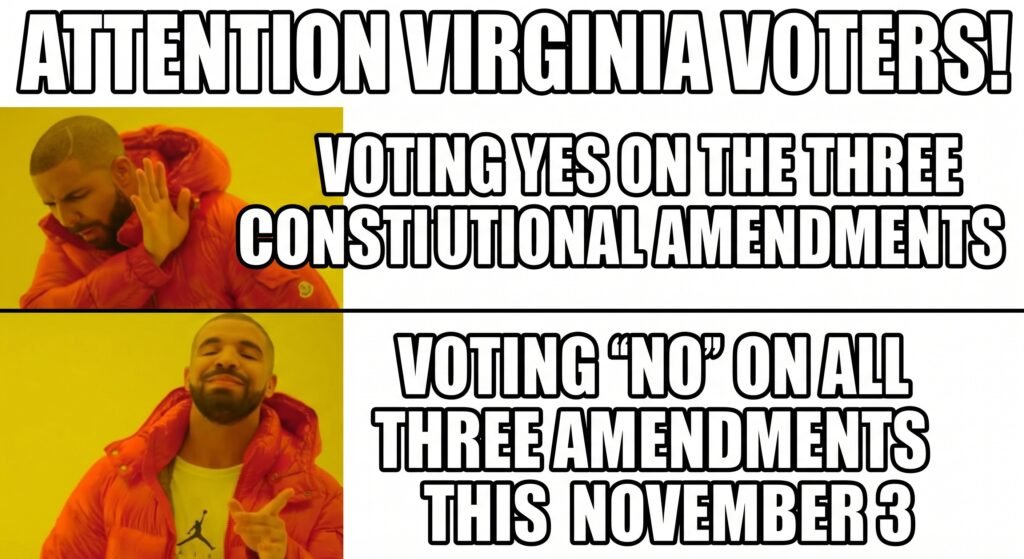
This November, Virginians will not just pick candidates. We will be asked to rewrite our state Constitution in three places. The General Assembly has sent voters three proposed amendments, and the political class is counting on the fact that most people never read past the headline. Read the actual language, and the answer to all three is the same. Vote no.
A word first about why these are on the ballot at all. Ordinary laws can be debated, amended, and repealed by the people we elect. A constitutional amendment cannot. Once it is written into the Constitution, it is locked away from the legislature and from you, changeable only by another multiyear amendment process. That is the whole strategy here. The goal is to take three contested questions out of the hands of your elected representatives forever and hand them to unelected judges. Even a voter sympathetic to one of these ideas should hesitate before cementing it beyond democratic reach.
Question 1: The Abortion Amendment
The first question is dressed up in the soft language of “reproductive freedom” and “personal decisions.” Strip away the marketing and look at what it does. It writes a nearly unlimited right to abortion directly into the Virginia Constitution.
The amendment permits restrictions only in the third trimester, and even then it carves out an exception whenever a patient’s “health” is said to be at risk. Anyone familiar with abortion law knows that a “health” exception, undefined and unlimited, is not an exception at all. It is a loophole that swallows the rule, because health can be stretched to mean almost anything. The practical effect is abortion on demand through all nine months, protected by the Constitution itself.
It gets worse. By enshrining these “decisions” as a constitutional right and shielding providers from being “punished,” the amendment threatens to sweep away the modest, common-sense protections Virginians have built over decades. Parental notification and consent for a minor child. Informed consent and waiting periods. Basic health and safety standards for the facilities themselves. All of it becomes constitutionally suspect the day this passes. Parents would lose the right to be involved when their own daughter faces the most serious decision of her life. No amendment that cuts parents out and guts safety standards deserves a place in our founding document. Vote no on Question 1.
Question 2: The Marriage Amendment
The second question asks voters to redefine marriage in the Constitution and to require that “all legally valid marriages” be “treated equally under the law.” Supporters frame this as simple fairness. It is not that simple.
Marriage between one man and one woman is the oldest and most fundamental institution of any healthy society, older than the Commonwealth and older than the country. Writing a new definition into our Constitution is not a neutral act. It is the state declaring, in its highest law, that this understanding no longer holds.
Notice also what the amendment does not contain. There is not one word protecting the conscience rights of Virginians who hold to the historic view of marriage. No protection for pastors, churches, religious schools, adoption agencies, or ordinary citizens whose faith is not a hobby but a way of life. The demand that all marriages be “treated equally under the law,” with no religious liberty carve-out, is an open invitation for future courts to force believers to violate their conscience or be punished for it. We have already watched this play out against bakers, florists, and adoption ministries elsewhere. Virginia should not hand activists a constitutional weapon and no shield for the faithful. Vote no on Question 2.
Question 3: The Felon Voting Amendment
The third question sounds procedural. It is anything but. Today, the restoration of voting rights to convicted felons is handled case by case. This amendment would make restoration automatic the moment a felon walks out of prison, regardless of whether he has finished parole, completed probation, or paid a dime of restitution to the people he harmed.
Voting is not merely a right. It is a trust, exercised on behalf of the whole community. A person who has broken the social contract badly enough to be convicted of a felony should have to complete the full sentence, every condition of it, and demonstrate that he has genuinely returned to lawful society before that trust is restored. Automatic restoration at the prison gate erases accountability and tells victims their harm no longer counts.
The same amendment quietly weakens the standard for barring those who cannot competently vote, swapping a clear “mental incompetence” test for a vaguer one. That is not reform. It is one more crack in the wall that protects the integrity of our elections. Vote no on Question 3.
One Ballot, One Answer
These three amendments have a common thread. Each takes a hotly contested moral and political question, decides it in favor of the left, and then bolts that decision into the Constitution where the voters can no longer touch it. That is not humility. It is the opposite. It is an attempt to win permanently what could not be won honestly at the ballot box year after year.
Conservatives believe in self-government, in the family, in the sanctity of life, in religious liberty, and in equal accountability under the law. All three of these amendments cut against those principles. When you receive your ballot this fall, read every question to the end, and mark no on all three.